
Hey, Let’s Talk About Fixing the "People’s House"
Why Expanding the People's Branch Is a Bipartisan Imperative
POLITICSCONGRESS
5/1/20268 min read
The Quick Version
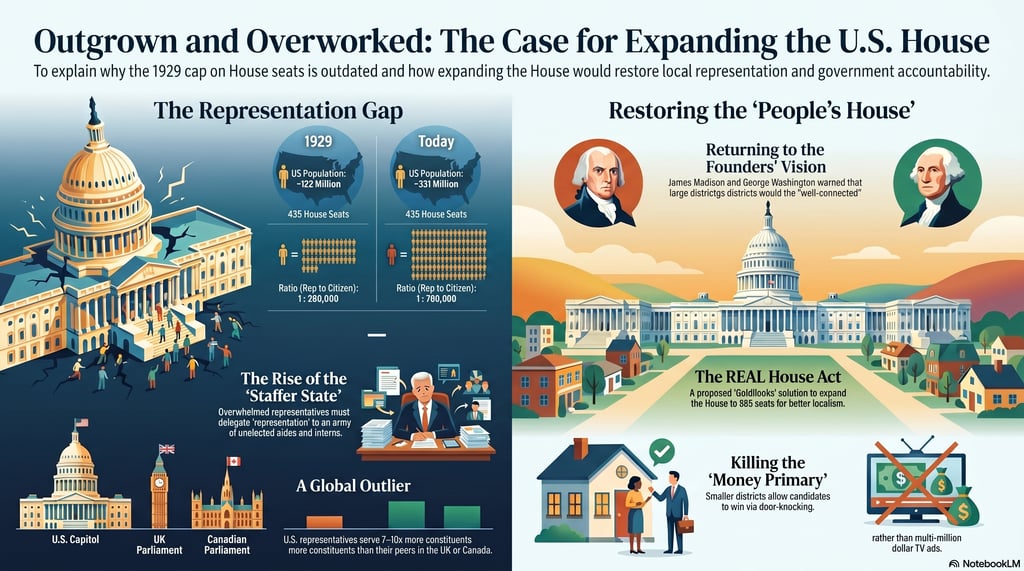
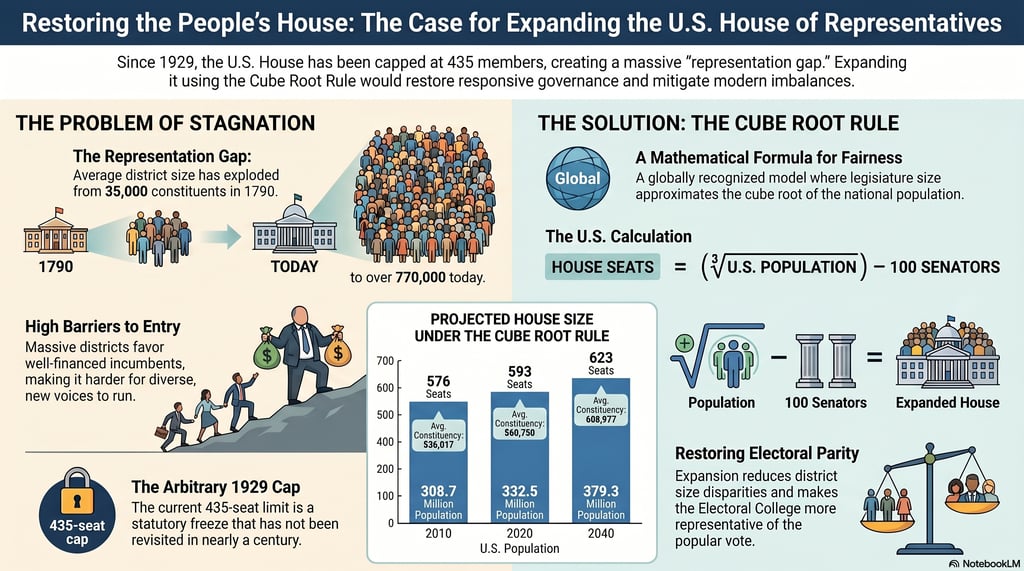
Right now, the U.S. House of Representatives is stuck in a bit of a time warp. Back in 1929, Congress passed a law that capped the number of representatives at 435. To put that in perspective, in 1929, the most popular car was the Ford Model A, the television was still a laboratory experiment, and there were only about 122 million people in the whole country. Fast forward to today, and we’re well over 331 million! While the country has nearly tripled in size and the complexity of our world has exploded, our "People’s House" has stayed exactly the same size.
Think of it like a pair of shoes you bought when you were ten years old. They might have been high-quality shoes—the best leather, perfect stitching—but as you grew into an adult, those shoes started to pinch. Eventually, those "frozen" shoes are going to give you blisters, stop you from walking, or just fall apart entirely. That’s where we are with the House. Because we’re squeezing way too many people into every single district, the "representational stretch" is reaching a breaking point. It’s getting harder for your representative to actually hear your voice through the noise of 760,000 other people. We aren't talking about a constitutional rule here—the Constitution actually expects the House to grow. This is just an old, dusty law from the era of the Great Depression that we can change with a simple vote. Let's dive into why adding some seats (like the REAL House Act suggests) is a great, common-sense move for everyone.
What were the Founders thinking?
Some folks think keeping the House small is the "traditional" or "conservative" way to go, but if you look at the history, it’s actually the opposite! The people who built this country wanted the House to be the most dynamic, growing, and "vibrant" part of the government—the part that stayed in constant motion with the people.
Madison's Big Idea: James Madison, the guy who basically wrote the blueprint for our government, was obsessed with the House staying close to the people. In Federalist No. 55 and 58, he warned that if the House stayed too small while the country grew, it would turn into a snobby, "aristocratic" club. He feared that a small group of reps would be too easy to corrupt or bribe, and that they would lose touch with the "spirit of the constituent." He wanted a House that was large enough to understand the local needs of a farmer in the mountains, a merchant in the harbor, and a frontiersman in the woods. If the districts got too big, he feared the reps would only have time to listen to the wealthy, the well-connected, and the professional "influence-peddlers."
The Washington Standard: Did you know George Washington almost never spoke up during the Constitutional Convention? He wanted to stay neutral and let the delegates debate. But on the very last day, he made a rare and powerful intervention for one specific thing: making districts smaller. He pushed to change the ratio from one rep for every 40,000 people to one for every 30,000. He believed that intimate, "door-to-door" connection was the "secret sauce" of a republic. If we followed Washington's lead today, we’d have over 11,000 representatives! Now, that might be a bit crowded for the cafeteria, but it shows how much he valued that one-on-one connection. He wanted you to know your rep, and more importantly, he wanted your rep to know you.
The 130-Year Streak and the 1929 "Backroom Deal": For over a century, Congress added seats every ten years like clockwork to keep up with the Census. It was just what you did—new people meant more voices. That stopped in 1929 because of a messy, partisan political fight. The 1920 Census showed a major shift: for the first time, more Americans lived in cities than on farms. Rural politicians panicked about losing their grip on power and literally blocked the House from growing for nearly a decade. The 435 cap wasn't a grand plan for "efficient government"; it was a "stop-gap" compromise designed to protect the status quo of the 1920s. We are effectively living in a house built for 1929 furniture, trying to fit a 2024 family inside.
Wait, isn't "More Politicians" a bad thing?
If you’re a fan of small government, your first thought might be, "Ugh, more politicians? That sounds like a nightmare! Won't that just mean more spending, more talk, and more red tape?" But believe it or not, the current "capped" setup actually makes the federal government bigger, more expensive, and way less accountable to you. Here’s how that paradox works:
1. Trading Reps for Bureaucrats (The "Staffer State")
When one person has to represent over 760,000 people, they physically cannot talk to everyone. Think about that: one person for three-quarters of a million people! It’s like trying to get a front-row seat at a sold-out football stadium when there's only one ticket booth for the entire crowd. The line never moves, and most people just give up and go home.
Because they're overwhelmed, representatives have to hire a massive army of unelected staffers, legislative aides, and professional lobbyists to do the actual work of "representing." Instead of talking to your elected official about a problem with your veteran benefits or a passport issue, you're talking to a 24-year-old intern or a "Constituent Services Liaison." You aren't getting "small government"—you're getting a "Staffer State" where the people you actually voted for are buried under layers of professional bureaucracy.
Plus, a tiny, overworked House is much easier for the President or big federal agencies to boss around. A single rep with 760,000 people to look after doesn't have the "bandwidth" to investigate every weird thing a government agency is doing. They become reliant on "briefing memos" from lobbyists. A larger House means more sets of eyes watching how your tax dollars are spent, which is the ultimate "small government" win. It turns "representatives" back into "overseers."
2. Making it cheaper to run for office (Killing the "Money Primary")
Right now, you practically need to be a millionaire (or know a bunch of them) to run for office. Because districts are so huge—covering multiple counties and hundreds of thousands of voters—you have to spend millions on TV ads just to get people to know your name. This creates a "Money Primary" where only the most well-funded candidates survive.
If we make districts smaller, "shoe-leather" politics comes back in style. A regular person—a teacher, a small business owner, a nurse, or a veteran—could actually win by knocking on doors and talking to their neighbors. If you only have to reach 400,000 people instead of 800,000, you don't need a multi-million dollar Super PAC; you just need a good pair of walking shoes and a clear, honest message. It breaks the monopoly that big donors and corporate interests have on our elections and lets someone run on ideas rather than just a huge bank account. It’s the ultimate "disruption" of the political establishment.
3. Ending the "Representation Outlier" Status
The U.S. is currently a total weirdo on the world stage when it comes to representation. In the UK, a Member of Parliament represents about 100,000 people. In Canada, it’s about 113,000. In most of Europe, it’s even fewer. We are asking our reps to do seven to ten times the work of their peers in other successful democracies. This isn't "efficiency"—it's a bottleneck. When the bottleneck gets too tight, the only people who get through are the ones with the most money and the loudest, most extreme voices.
A Simple, Bipartisan Fix
We don’t need to jump all the way to Washington's 11,000 members, but we definitely need to get the gears of democracy moving again. The REAL House Act is a great "Goldilocks" proposal—not too big, not too small. It suggests moving to 585 seats, which is a manageable, measured step that gets us back on a healthier track.
For the Right: Restoring Localism and Community. Smaller districts mean "local" actually feels local again. Right now, some districts are so big they cover multiple counties with totally different needs—maybe one end is a bustling urban port and the other is a quiet farming community. The rep ends up pleasing no one. In a smaller district, your rep can focus on your actual community and its specific values. It’s a return to "community-based" governance.
For the Left: Electoral College Fairness. It makes the Electoral College much more reflective of where people actually live. Right now, because the House is capped, people in fast-growing states like Texas, Florida, or Arizona, or massive states like California, have much less "voting power" per person than people in smaller states. Expanding the House fixes that math automatically. It’s a way to make the system fairer for every voter without needing a complicated, "break-the-glass" Constitutional Amendment that would take decades to pass.
For Everyone: Breaking the "Two-Party Doom Loop." It opens the door for things like Ranked Choice Voting (RCV) and multi-member districts. When you have more seats, you can have more voices. It helps break that "us vs. them" cycle where we feel like we only have two choices, and both of them feel "meh." It gives third parties, independent thinkers, or even just creative reformers a real seat at the table. It lowers the temperature of politics because reps have to build broader coalitions to get anything done.
But where will they all sit? (The "Logistics" Myth)
The most common worry is, "Is there even enough room in the building?" It sounds like a punchline, but it's a real logistical question. But honestly, if we can put a man on the moon, build 100-story skyscrapers, and manage a 3.5 trillion dollar budget, we can find room for a few extra desks!
Other countries are already doing this in much tighter spaces. The UK has 650 members in their House of Commons, and they literally sit on benches that look like they're from a choir loft. Germany has over 700 members. They make it work!
The "Architect of the Capitol" Solution: We’ve renovated the Capitol many times before—adding wings, building the massive dome, and expanding the underground visitor center.
The High-Tech House: Between modernizing the Capitol layout, using existing office buildings nearby, and using technology for things like secure digital voting or virtual town halls, we can easily handle the growth. In 1912, they actually removed the individual desks and replaced them with benches to make room. We can be just as creative today.
Why "Unwieldy" is a Myth
You’ll hear people say a bigger House would be "too messy" or "unwieldy." But think about it: is the House "working" right now? Most people would say no. A small House is actually easier to control from the top down. Right now, the Speaker of the House holds almost all the power because they only have to keep a small, tight-knit group in line.
A larger House actually forces more collaboration. When you have more members, you can't just have one or two "gatekeepers" at the top controlling every vote. You have to build broader, more diverse coalitions. It actually moves the power away from the Speaker’s gavel and back toward individual members, which is exactly how the system was designed to work. More members mean more debate, more ideas, and a system that is harder to "capture" by a single faction.
The Bottom Line
The 435-seat cap was a 100-year-old "quick fix" for a political argument from the era of silent movies and telegrams. We’re trying to run a 21st-century superpower on a 1920s engine, and it’s starting to stall out. We've outgrown the cap, and the tension is showing in our polarized politics, our "Staffer State," and our frustrated citizens who feel like no one in Washington is listening.
Expanding the House isn't about making the government bigger—it’s about making it yours again. It's about making sure that when you have a problem, a question, or a great new idea, your representative is actually close enough to hear you. Let’s bring the "People’s House" back to the people and build a legislature that’s actually sized for the greatest, most diverse nation on Earth!
Audio
Podcast

Contact
Questions or thoughts? Email us or comment to the posts.
© 2026. All rights reserved.