
The Echo Chamber and the Arena
Explore the contrasting strategies in staff loyalty, global diplomacy, and crisis management between Presidents Bartlet and Trump. Understand how these critical areas interact and influence organizational success.
4/8/20265 min read
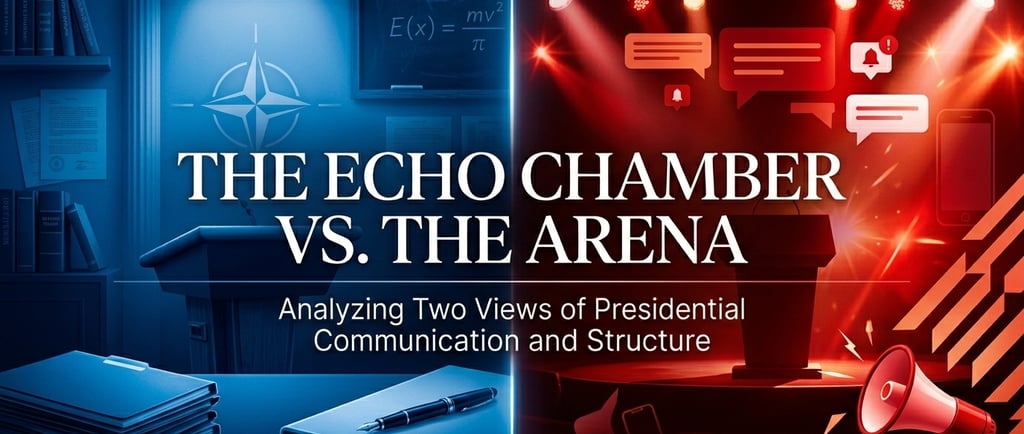
The American presidency is described as the most powerful office in the world. In the cultural zeitgeist, two figures stand as polar opposites of the executive archetype: Josiah "Jed" Bartlet, the fictional Nobel laureate from The West Wing, and Donald J. Trump, the 45th and 47th President of the United States.
One was born of the idealism of a Hollywood liberal and the other of a populist (some may say nationalist) movement. Comparing them reveals a sharp divide in leadership, rhetoric, and the role of the "President’s Men."
1. Governance and Philosophy: Intellectualism vs. Instinct
At the core of Josiah Bartlet is the intellect. A descendant of a signatory of the Declaration of Independence, Bartlet is a Nobel Prize winner in Economics who speaks Latin and treats politics as if it were a chess match. He believes in the sanctity of the office and the power of government to be a force for moral good.
In contrast, Donald Trump governs via disruption. If Bartlet is a chess player, Trump is a poker player who beats his opponents with unpredictability. Trump prefers a transactional approach to diplomacy. Where Bartlet seeks the "best version" of an argument through rigorous debate, Trump relies on his gut instinct and the leverage of his personal brand.
2. The Press: The Briefing Room vs. The Bully Pulpit
The relationship with the Fourth Estate is a "temperature check" for any administration.
The Bartlet Approach: Managed Respect In the Bartlet White House, the Press Secretary (C.J. Cregg) views the press as a necessary, and an occasionally difficult partner in a democracy. Bartlet treats reporters like students in a graduate seminar—he might sometimes be condescending but he respects the institution of the White House Press Corps.
The Trump Approach: Direct Combat Donald Trump redefined the relationship by labeling the mainstream media as “fake news” and the "enemy of the people." Trump uses Truth Social to bypass the press entirely…Thank you for the attention to this matter. He treats the briefing room as the Roman Coliseum…a theater of combat, a competitor in framing of a story. Trump frequently engages in personal attacks of reporters, think “piggy”, “nasty”, “ugly”, “dumb”, and “stupid”.
3. The Machinery: Staff, Cabinet, and Joint Chiefs
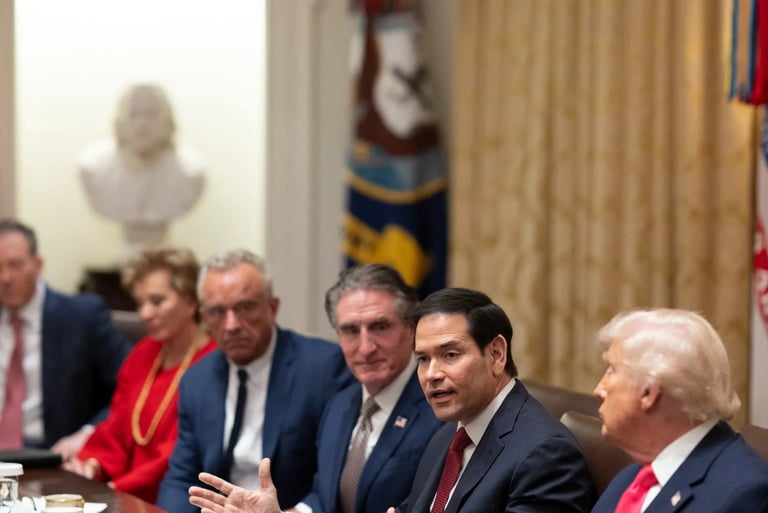
A President is only as effective as the people he surrounds himself with. The contrast here is perhaps the most striking of their respective tenures.
The Inner Circle
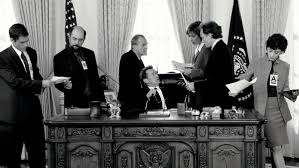
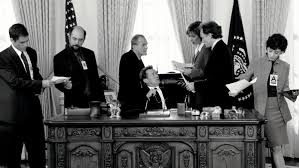
● The Bartlet Staff (The Knights): Leo McGarry, Josh Lyman, and Toby Ziegler function as a high-performing dysfunctional family. They are characterized by ideological purity. Conflict is intellectual, and loyalty is to the mission.
● The Trump Staff (The Disruptors): Defined by high turnover and internal competition. Trump frequently brought in family members, “yes” men/women, and fringe podcast hosts valuing raw authenticity over traditional experience.
The Cabinet and Joint Chiefs
● Academic Expertise (Bartlet): Bartlet’s Cabinet is filled with "the best and the brightest." His Joint Chiefs Chairman, Admiral Percy Fitzwallace, is a "soldier-statesman"—steady and deferential to civilian authority.
● Sector Dominance (Trump): Trump’s Cabinet favors "disruptors" from the private sector; a news host for Secretary of War, a plumber for the head of DHS, and a podcast host for Deputy Director of the FBI. His relationship with military leadership was often frictional in the first term; figures like General Mark Milley often found themselves acting as a "buffer" between the President’s instincts and established military norms. We will see how long “Raizin” Caine will last now that he has to direct a war.
4. Foreign Policy: NATO Allies and the "Strongman" Dynamic
Nowhere is the divide between Bartley’s Institutionalism and Trump’s Transnationalism clearer than in the arena of global diplomacy.
NATO and the Liberal Order
Bartlet views NATO as the "shield of democracy." In his world, an attack on one is an attack on all, and the United States’ role is to provide the moral and military glue that holds the world together. His diplomacy is conducted through back channels, State Department protocols, and a deep respect for the post-WW2 international order.
Trump views NATO through the lens of a balance sheet, frequently accusing European allies of being "delinquent" on their defense spending and not being there for the US in the past…despite the only time Article 5 of the NATO treaty has been invoked was after 9/11. In the post-9/11 War or Terror NATO countries sacrificed their soldiers alongside the US, a fact that Trump seems to not be aware of. He has recently questioned the fundamental utility of the alliance, suggesting that he will withdraw America from NATO despite him not having the power to do so…but that hasn’t stopped him from promising it. His approach is designed to force a "better deal" for America at the expense of traditional and nontraditional diplomatic relationships.
Foreign Despots and Strongmen
The two leaders also differ in how they handle the world’s most dangerous actors.
● Bartlet’s Moral Distance: Bartlet treated dictators with a cold, academic disdain. When he authorized the assassination of Abdul Shareef, it was a move of last resort that caused him profound spiritual distress.
● Trump’s Personal Diplomacy: Trump believes in the power of the "personal touch" with strongmen. From his summits with Kim Jong Un to his rapport with Vladimir Putin and Viktor Orbán (Founding Member of ‘The Board of Peace’), Trump seeks to build personal relationships that bypass traditional diplomacy. He often praises the strength of these leaders, a move that horrified institutionalists but which he argues is necessary to "make a deal" and prevent conflict. A skill he displayed in causing the open Straight of Hormuz to be closed and is now negotiating its opening again.
5. Crisis Management: Comparing the Unthinkable
The Pandemic: Smallpox vs. COVID-19
● Bartlet’s Response: During a smallpox scare, he leant heavily on the CDC. He viewed himself as the Chief Educator, using the crisis to explain the science to the public.
● Trump’s Response: During COVID-19, Trump was skeptical of the scientific bureaucracy. He prioritized economic reopening and personal messaging, clashing with public health officials.
Succession and Legitimacy
● The 25th Amendment (Bartlet): When his daughter was kidnapped, Bartlet voluntarily stepped aside to preserve the office. It was the ultimate institutional sacrifice.
● January 6th (Trump): The end of the first Trump administration was marked by a challenge to democracy itself, leading to a historic clash with the legislative branch as he sought to contest the election and a peaceful transition of power that has been the hallmark and beacon of democracy.
Conclusion: Two Visions of America
Josiah Bartlet represents the Aspirational Presidency—the leader who stays up late reading books, understands the system is flawed, but works tirelessly to perfect it. Donald Trump represents the Provocateur Presidency—the leader who feeds on the ignorance and fear of his electorate. One sought to master the rules; the other sought to ignore and rewrite them.
Contact
Questions or thoughts? Email us or comment to the posts.
© 2026. All rights reserved.