
The Final Four Cold War: Why the Staley-Auriemma Rivalry Has Become Toxic for the Game
A critique of the toxic rivalry between Geno Auriemma and Dawn Staley, arguing during the Final Four are setting a damaging example for the young girls who look up to them.
WOMEN'S FINAL FOURDAWN STALEYGENO AURIEMMA
4/4/20263 min read
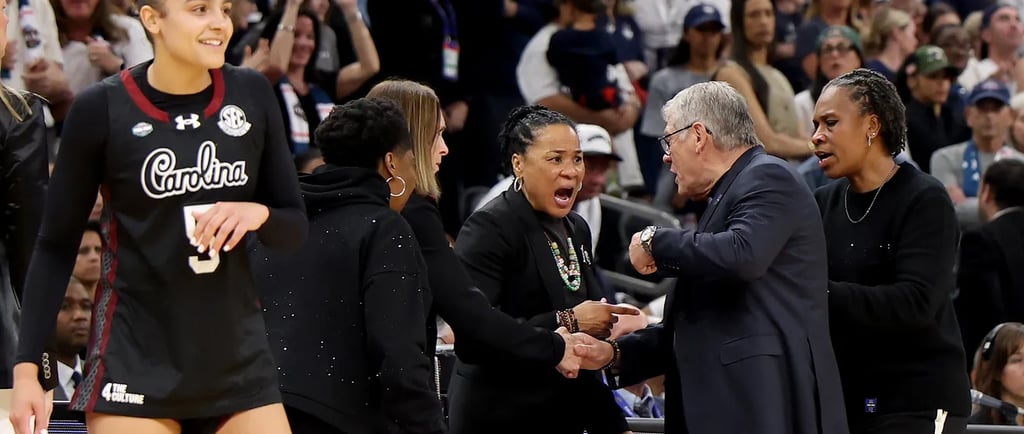
The Final Four is supposed to be the pinnacle of women’s basketball—a showcase of elite talent, grit, and sportsmanship. Instead, the recent showdown between UConn and South Carolina felt less like a masterclass in hoops and more like ego.
While the media loves to frame the tension between Geno Auriemma and Dawn Staley as a "clash of titans," the reality is starting to look a lot more like a lack of professionalism. From the opening tip to the post-game pressers, both coaches managed to overshadow their players' brilliance with their own personal grievances.
Dawn Staley: Confidence or Categorical Pomp?
There is a fine line between a coach standing up for their program and a coach adopting a "larger-than-the-game" persona. Lately, Dawn Staley seems to have crossed it.
Throughout the tournament run and leading into the Final Four, Staley’s demeanor leaned heavily into a pompous attitude that borders on the dismissive. While she has built a juggernaut at South Carolina, the constant "us against the world" narrative—even when they are the undisputed favorites—has shifted from motivating to exhausting. Staley’s insistence that she is the sole arbiter of "integrity" while refusing to engage in standard coaching protocols, like the pre-game handshake at mid-court, sends a message of superiority rather than sportsmanship.
According to reports from Sports Illustrated, the post-game handshake line devolved into a heated confrontation where Staley had to be separated from Auriemma, further proof that the rivalry has transitioned from competitive to personal.
Geno Auriemma: Deflection and Disinformation
On the other side of the court, Geno Auriemma’s veteran status doesn't give him a pass for playing fast and loose with the facts. In a moment of high-tension frustration, Auriemma made a pointed assertion regarding a jersey tear, claiming the physicality of the Gamecocks had reached a point of literal destruction.
The problem? The cameras—and his own player—didn't back him up. As reported by On3, freshman Sarah Strong admitted after the game that she accidentally ripped her own jersey after a missed shot. Using a manufactured "equipment crisis" to lobby for whistles is a tired tactic. For a coach of his stature to resort to such petty deflections—rather than addressing his team’s execution—is a disservice to the UConn legacy.
A Cycle of Mutual Disrespect
The most disappointing aspect of this rivalry isn't the tactical chess match; it’s the continuing mutual disrespect displayed on a national stage. This isn't just about two coaches who don't like each other; it's about the environment they are creating for the entire sport.
The Handshake Protocol: Auriemma publicly complained about waiting at halfcourt for a pre-game handshake that never happened, as detailed by The Guardian.
The Sideline Sniping: Auriemma accused Staley of "ranting and raving" and calling officials names, while Staley dismissed his complaints by telling reporters to "ask Geno" about his own behavior.
The TV Audience: Millions of viewers tuned in to see world-class basketball, only to be met with a broadcast dominated by sideline sniping and post-game passive-aggressiveness.
What Are We Showing Young Girls?
The most damaging part of this display isn't the technical fouls or the box score—it's the message sent to the thousands of young girls watching. We tell young athletes to "honor the game," to "shake hands win or lose," and to "respect their opponents." Yet, the two most visible leaders in the sport are currently modeling the exact opposite.
When Dawn Staley acts as if she is above the standard protocols of the game, she teaches young girls that success excuses arrogance. When Geno Auriemma uses lies about a "ripped jersey" to deflect from a loss, he teaches them that accountability is optional if you can find a scapegoat.
Coaches are the primary architects of a sport's culture. If the leaders at the top can’t treat one another with basic professional courtesy, we cannot be surprised when that toxicity trickles down to AAU courts and high school gyms across the country.
The Bottom Line
Geno needs to stop looking for excuses in the fabric of a jersey, and Dawn needs to check the arrogance at the door. The players deserved a spotlight on their performance; instead, they got a front-row seat to a coaching feud that has officially overstayed its welcome. It's time to grow up for the sake of the girls who are looking up.
Joe Camporeala, Image Images
Contact
Questions or thoughts? Email us or comment to the posts.
© 2026. All rights reserved.